

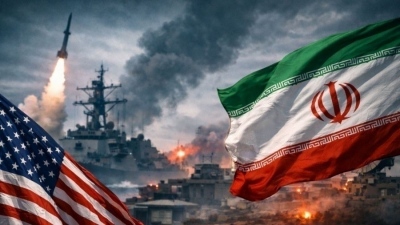
The war triggered by the United States and Israeli attacks against Iran has already left behind a heavy toll: more than 1,400 dead (officially), extensive destruction of urban infrastructure, and a rapidly ballooning humanitarian crisis. At the same time, Tehran's retaliation against targets in the Gulf and Israel has intensified fears of generalized destabilization in the region, while international energy markets are already reacting with a sharp rise in oil prices above $100 per barrel. Eighteen days after the start of hostilities, concerns are now shifting from the military field to the humanitarian consequences. That is, to the day after. The UNHCR estimates that at least 3.2 million people have been displaced within the country, a number that grows daily as attacks hit residential areas in major cities such as Tehran, Shiraz, and Isfahan. The pressure within Iran is increasing dramatically.
More than 10,000 civilian sites—including schools and hospitals—have been damaged, while the disruption of flights and the closure of airspace intensify the country's isolation. Experts warn that a potential collapse of critical infrastructure, such as the electrical grid or Tehran’s water supply, could trigger a massive exodus of millions of people in a very short time.
Infrastructure collapses, paving the way for mass population flight
This possibility is causing alarm in neighboring countries. Iran borders seven states—including Turkey, Iraq, and Pakistan—which are already dealing with their own economic and political pressures. Turkey, in particular, which hosts millions of refugees from Syria, fears a new crisis of similar or even greater scale, and of course, Greece, which is located nearby.
Analysts point out that unlike Syria, where the refugee crisis evolved gradually, the destruction of critical infrastructure in Iran could cause an abrupt and mass movement of populations. The scale of the problem is potentially enormous: with a population of approximately 90 million, even a displacement rate similar to Syria's would lead to tens of millions of people on the move.
The domino effect of the war in Iran
The situation is further complicated by the fact that Iran itself already hosts millions of refugees, mainly from Afghanistan. This creates a "double crisis," where both Iranian citizens and already displaced populations risk finding themselves in a state of forced relocation once again. At the same time, the conflict directly affects the stability of the entire region. Iraq is in the middle of exchanging attacks, while regions of the South Caucasus and Central Asia are watching with increasing concern. To the east, Afghanistan and Pakistan, already burdened by previous refugee flows, risk receiving a new wave of people who have nowhere else to go.
In this environment, the geopolitical debate over the results of the conflict is also intensifying. Despite the intensity and scale of the operations, no clear strategic outcome has emerged so far, while the conflict seems to be leading more toward destabilization than resolution. Some analysts speak of a development that undermines the prestige of US strategy, as the repercussions spill uncontrollably into the wider region. The biggest question now concerns not only the outcome of the war but what will follow. If the crisis escalates further, the world may face one of the largest refugee crises of modern times—a crisis that will not be limited to the Middle East but will directly affect Europe and international stability as a whole.
Tensions and conflicts at the borders
The situation is even more complicated by the tensions between Pakistan and Afghanistan. Islamabad accuses Kabul of providing sanctuary to armed groups carrying out attacks on Pakistani soil—something the Afghan side categorically denies. In October 2025, a new flare-up of conflicts led to the closure of the borders, while simultaneously strengthening Afghanistan's commercial ties with Iran. As analysts point out, the destabilization of the Iranian economy hits Afghanistan twice: through the reduction of trade and through the return of a large number of refugees.
The volatile Balochistan front
At the same time, Pakistan faces serious challenges in the Balochistan province, where the borders with Iran are porous and instability is long-standing. The region serves as a hotbed for separatist movements, has seen increased attacks in recent years, and is at a critical point between Iran and Pakistan. Just in February, the Pakistani army announced it had killed 216 militants in a security operation. Although local authorities state they can manage a potential influx of refugees, analysts warn that the reality is more complex.
www.bankingnews.gr




Σχόλια αναγνωστών